
Clue is a Stripe App that tells you whether to trust the person behind a payment. Open any payment or customer in your Stripe Dashboard and Clue checks the buyer's email, phone, addresses, property records and IP, adds what your own Stripe account already knows about them, and gives you one verdict with the reasons behind it. It is live on the Stripe App Marketplace today.
I want to explain why we built it, how it decides, and where it stops, because a fraud tool you can't see into is a tool you end up ignoring.
Manual review on Stripe is six tabs and a hunch
Here is how a risky order gets reviewed at most of the merchants we work with. Someone opens the payment in Stripe and looks at the Stripe Radar score. Then they open a new tab and search the email. Another tab for the phone number. A map for the shipping address, to see if it's a house or a strip mall. Maybe a county records site, if they know which county. Then back to Stripe to scroll the customer's history, which shows a few payments per page, so they click through to another view that shows a few more.
Twenty minutes later they have a feeling, not an answer. The evidence lives in their head and in a spreadsheet, and none of it makes it back into Stripe.
The risk analysts we've worked with and interviewed describe the same frustrations, almost word for word. The information they need is spread across several tools that don't talk to each other. Vendors hide the useful parts behind extra clicks. And the insights they do find can't be turned into anything, because a hunch in a browser tab isn't a Radar rule.
Radar is very good at what it does. It scores the card and the transaction using Stripe's network. What it doesn't do is check the person: whether this email has existed for more than a month, whether the phone belongs to the name on the order, whether anyone actually lives at the shipping address. That's the gap Clue fills.
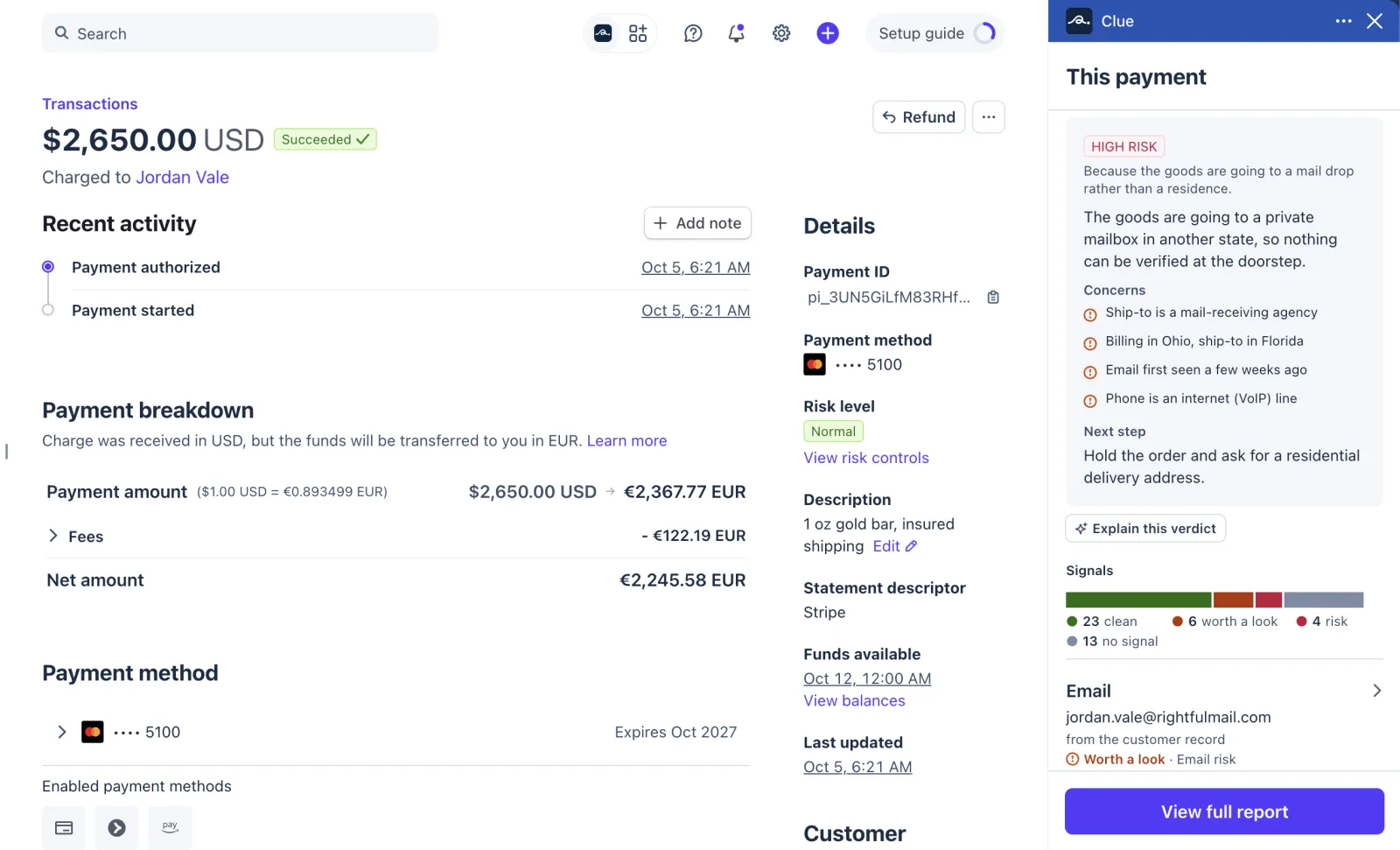
What Clue shows you when you open a payment
Clue lives in the drawer on the right side of the Stripe Dashboard. Open a payment or a customer and you get:
- A verdict: Looks legitimate, Verify before shipping, High risk, or Not enough data.
- One sentence explaining it, in plain English. For example: "The goods are going to a private mailbox in another state, so nothing can be verified at the doorstep."
- A tally of what agreed, what's worth a look, what contradicts the buyer, and what came back empty.
- A suggested next step, such as "hold the order and ask for a residential delivery address."
That's the glance. It's built for the analyst who has forty flagged orders before lunch. When one needs more, every category opens into its own detail view: email, phone, person, addresses, card, network, linked customers and payment history. Each one shows the Stripe value Clue looked up, every check it ran, what came back, and the conclusion.
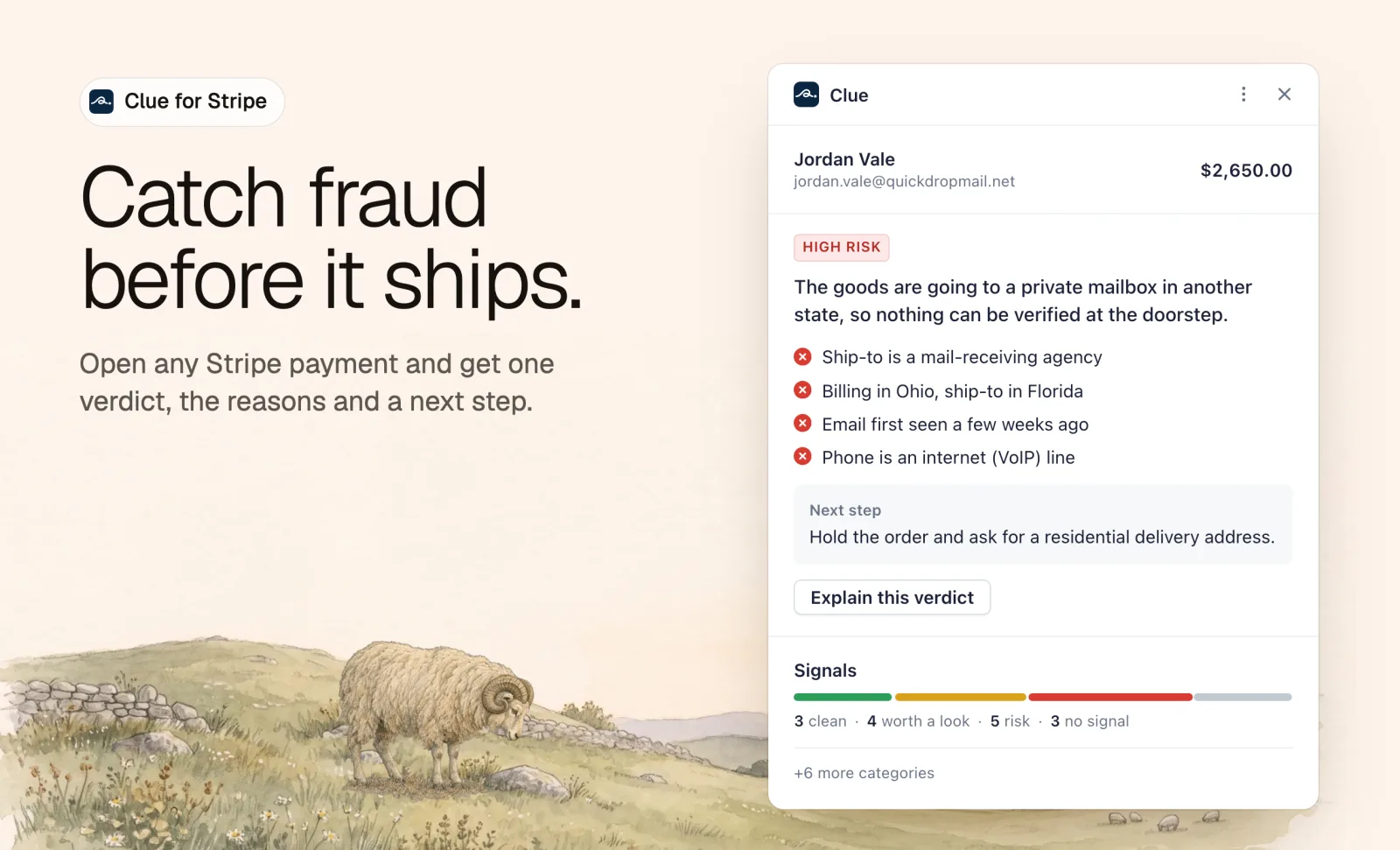
Behind the verdict are more than 80 signals: email age and domain age, data breaches, disposable domains, phone carrier and line type, whether the carrier's account name matches the buyer, USPS deliverability, mail-drop and vacant addresses, property and deed records, a public-record identity match, VPN, proxy, Tor and data-center IPs, and your own customers who share the same card, phone, email or ZIP.
The verdict is code. The AI writes the explanation.
This was the most important design decision we made, and the one I'd defend hardest.
The label at the top of the drawer is computed by fixed rules, in order, first match wins. A disputed payment or an early fraud warning on file is high risk. A ship-to address that is a mailbox store is high risk for a merchant that ships physical goods. A buyer whose name, phone and address contradict each other is high risk. A clear verdict needs three things together: an identity that holds together, a loaded history, and at least one strong positive signal, like the buyer being on the deed of the delivery address.
A language model then writes the one-sentence summary and answers "explain this" when you ask. It never picks or changes the label. If the model is slow or fails, you lose a sentence, not the verdict.
Why be this strict? Because you're going to act on that label. You'll hold an order, cancel it, or ship $12,000 of goods on it, and you need to know it means the same thing every time. An AI that decides fraud verdicts can be talked into a different answer by a slightly different input, and you can't audit a judgment you can't reproduce. AI is very good at reading twenty data points and telling you which two matter. That's the job we gave it.
Tuned to what you sell
The same buyer can be fine for one business and a problem for another. A new email and a VPN mean little for a software subscription. For a bullion dealer shipping gold to a first-time buyer, a ship-to address the buyer doesn't own is the whole question.
So when you install Clue, it reads your Stripe business category, your business profile and your website, and sets which signal families are allowed to move the verdict for you, and how far. A deed mismatch can be decisive for one merchant and only a note for another. You can change your business description, how you deliver, and what counts as a large order in Clue's settings, and your edits stick.
Two things can never be tuned away: a dispute or an early fraud warning on the customer's payments. Those are Stripe's own facts about your own customers, not a guess about a stranger.
The defaults come from our consulting work. Our team has spent years inside merchants' Stripe accounts during attacks (our founder spent six years at Stripe on risk), and the weightings are the ones our analysts would apply by hand.
Verify before you ship: the deed check
Our first user is a precious-metals dealer. Their buyers skew older, American, and most own their homes. Their fraud is high-ticket and physical: a stolen identity, a real card, and gold shipped to an address the fraudster controls. Every card check passes because the card details are real.
For them, one question decides most orders: does public record say this buyer owns the home the goods are shipping to? Clue checks county property and deed records for that address and tells you whether the buyer is on the deed and whether they appear to live there. If they are, and the rest of the identity holds together, that's the strongest clearance signal we have. A $12,400 first order from someone who has owned the delivery address since 1998 and has used the same email since 2010 is not the order to lose sleep over.
If the deed names someone else, Clue says so. It doesn't jump to fraud, though: people send gifts and own second homes. When the buyer owns the billing address but not the ship-to address, Clue treats it as a question and asks you to verify, rather than calling it fraud.
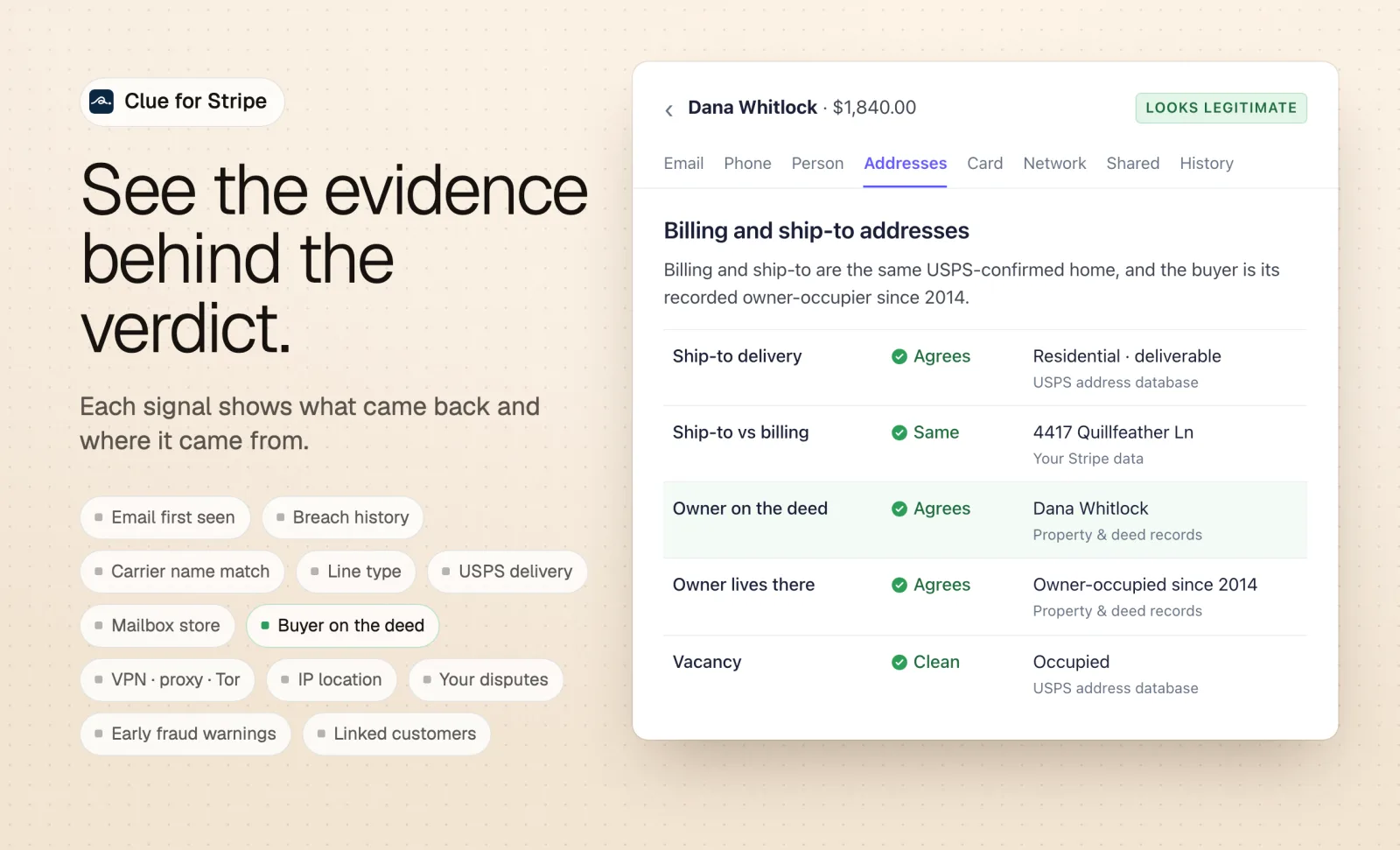
Property, deed and USPS checks cover US addresses today. Email, phone, IP and Stripe-history checks work wherever your customers are.
Spotting the payments likely to turn into disputes
Clue doesn't claim to predict chargebacks with a score. What it does is surface the patterns we see behind fraud disputes over and over, before the goods leave:
- A shipping address that is a mailbox store, a freight forwarder or vacant.
- An identity that doesn't hold together: a name the phone carrier has never heard of, an email created three weeks ago, a billing address in Ohio and a ship-to in Florida.
- A connection from a data center or VPN when the buyer claims to be at home.
- A customer who shares a card, phone or email with another customer in your account who already disputed.
- A returning buyer under a new email. Clue lists your other customers with the same card, phone, email or billing ZIP, and you can open each one.
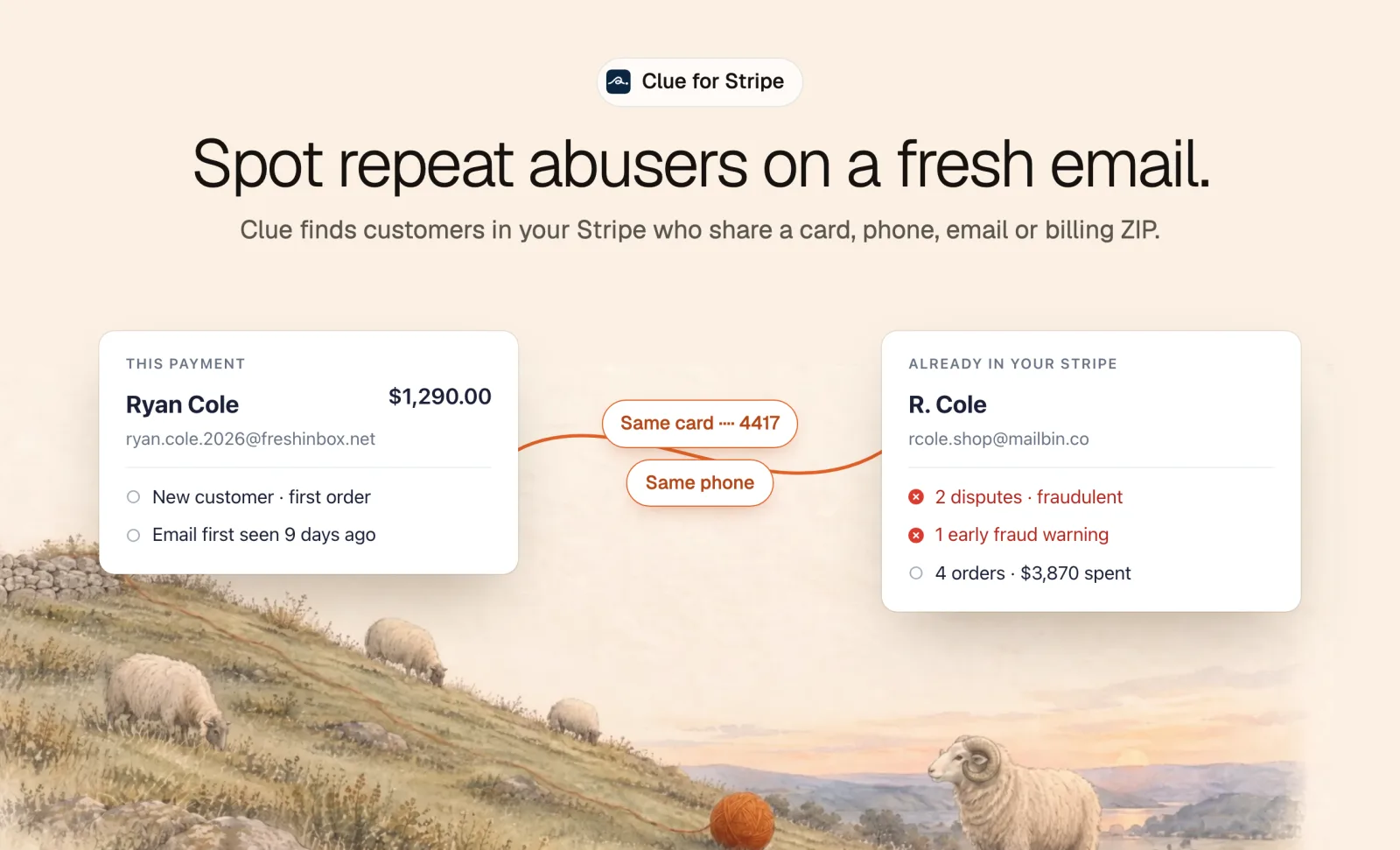
None of these is fraud on its own. A new email is a new email. Clue's job is to put them side by side so you see the combination, which is where fraud usually shows itself.
Glance first, everything visible
We rebuilt the drawer twice to get this right. An early redesign gave a beautifully clean summary and hid the working, and analysts stopped trusting it. If you can't see how a conclusion was reached, you can't defend it to your boss, to your customer, or to yourself.
So Clue follows a few rules:
- Nothing hides. "Not searched", "searched and found nothing", "lookup failed" and "found something that differs" are four different results, and Clue shows them as four different things. Missing data is never shown as a pass.
- Every result says which Stripe value was checked and what type of source answered it: carrier records, property and deed records, USPS address data.
- Explain is available everywhere. Ask why a signal matters for this order and you get an answer grounded in the checks on screen.
- Four colours only: agrees, worth a look, risk, no signal.
The analyst who uses Clue most opens it on orders that already look risky, reads every tab, and asks it to explain more often each week. That's the behaviour we designed for: a fast first read, then as deep as you want to go.
What Clue doesn't do
- It doesn't block payments. Radar does that. Clue tells you what you're looking at so you can decide.
- It doesn't contact your customers or ask them for anything. They don't know a check ran.
- It doesn't write to your Stripe account. It's read-only.
- It isn't a consumer report and must not be used for credit, employment, housing or insurance decisions.
- It doesn't send raw emails, phone numbers or IP addresses to the AI model, and the model never sees record values from our data sources.
- It doesn't need a particular Radar plan. It works on Radar Lite too.
- We don't publish an accuracy rate. Records are imperfect, and Clue says plainly when they say nothing. Treat the verdict as a well-informed starting point.
Pricing and how to install
Every Stripe account gets 1,000 free credits the first time Clue runs in live mode, with no card required. A fresh check uses at most 36 credits, so that's at least 27 full checks, and reopening a buyer you checked in the last 24 hours is free. After that, plans start at $50 a month. Full details are on the Clue page.
A Stripe administrator can install Clue from the Stripe App Marketplace in about a minute. It also runs in test mode and sandboxes with sample buyers, so you can see it before you point it at real customers.
Try it on your next order
If you sell high-value goods on Stripe, or you have someone reviewing orders by hand in six tabs, install Clue and open the next order you were unsure about. And if what you're dealing with is bigger than one order at a time, talk to our team. I'd also love to hear what you'd want it to check next.
Frequently asked questions
Clue is a Stripe App by Canonical Labs that gives a fraud verdict on any Stripe payment or customer. It checks the buyer's email, phone, addresses, property records and IP, adds your own Stripe history, and shows one verdict (Looks legitimate, Verify before shipping, High risk or Not enough data) with every check behind it.
Radar scores the card and the transaction using Stripe's network and can block payments. Clue checks the person behind the payment: email and domain age, phone carrier and line owner, whether addresses are real homes and whether the buyer is on the deed, and the IP. They work together, and Clue shows Radar's scores in the customer's history.
No. Fixed rules, applied in order, set the verdict label. An AI model writes a one-sentence summary and answers on-demand questions about the checks, but it never picks or changes the label. Disputes and early fraud warnings on a customer always count and can never be tuned away.
Yes, for US addresses. Clue checks county property and deed records to see whether the buyer is on the deed of the delivery address and appears to live there. A deed in someone else's name is flagged for verification rather than treated as fraud, since gifts and second homes are common.
Each Stripe account gets 1,000 free credits the first time Clue runs in live mode, enough for at least 27 full checks, with no card needed. Paid plans start at $50 a month, and reopening a buyer checked within the last 24 hours costs nothing.